Inventing Prosperity: Science, Technology, and the Future of American Innovation*

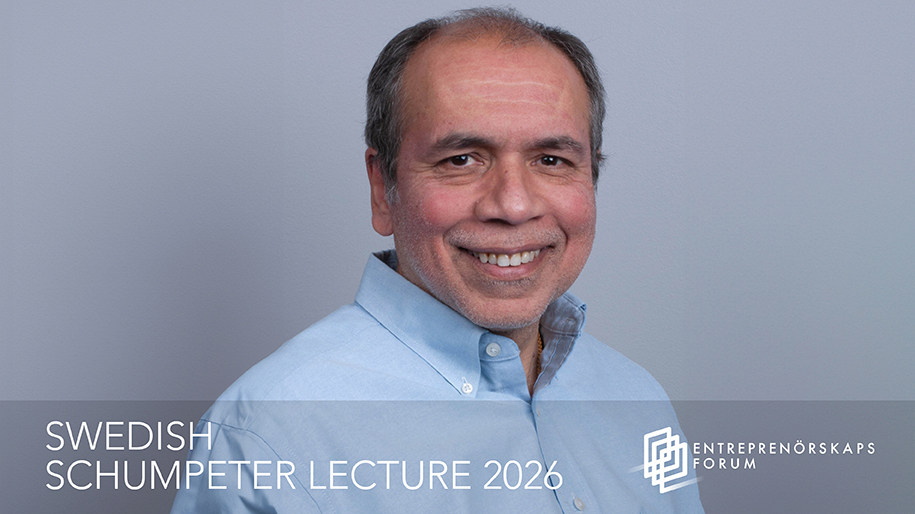
On 13 May 2026, the annual Swedish Schumpeter Lecture was held at the House of Innovation, Stockholm School of Economics, co-hosted with Swedish Entrepreneurship Forum, made possible by funding from Handelsbankens forskningsstiftelser. The lecture took as its starting point a paradox: research investment has grown steadily, yet productivity growth has stalled.

Introduction

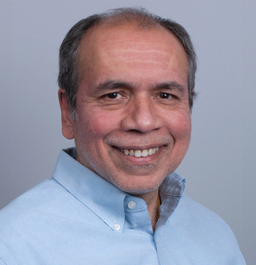
Karl Wennberg, Professor at Stockholm School of Economics, and Anders Broström, Managing Director Swedish Entrepreneurship Forum and Professor at the University of Gothenburg, opened the seminar by placing the lecture in the Schumpeter series tradition and introduced this year’s speaker, Professor Ashish Arora, a central reference point in research on the U.S. innovation ecosystem.

Anders Broström and Karl Wennberg

A misdiagnosed problem

Ashish Arora, Rex D. Adams Professor of Business Administration, Fuqua School of Business, Duke University, began with the symptom: U.S. research expenditure has risen continuously, yet total factor productivity growth peaked in the two decades after World War II. Influential papers have argued that science and technology have become more incremental, and that universities therefore need reform.

Arora argued this diagnosis is wrong. While the average paper or patent may have become less disruptive, the best science has not – and what drives progress is the frontier, not the mean. Breakthroughs such as AlphaFold, quantum computing, and large language models support this view. Furthermore, private R&D investment has steadily increased; if ideas were genuinely harder to find, rational investors would invest less, not more.

The real bottleneck: translation

The problem, Arora contended, lies in translating science into commercial products. A key cause is the withdrawal of large corporations from research: the share of U.S. business R&D devoted to basic and applied research has fallen from roughly one-third at its peak to around one-fifth today. Stock markets, which once awarded a premium to scientific capability, no longer do so. Firms have effectively moved from R to D within R&D – and with this shift, their ability to absorb external scientific knowledge has weakened.

Ashish Arora

A new division of innovative labour – and its limits

The U.S. innovation system has shifted to a division of labour in which universities produce science, startups translate it, and incumbents handle scale-up. The mRNA vaccine illustrates the model’s success. But it works far better in some sectors than others: venture capital has concentrated overwhelmingly in software and life sciences, while deep tech and new materials are largely shut out.

The bottleneck is not capital. Arora showed that science-based startups create more value than non-science-based ones but capture a smaller share of it. Because exit conditions are poor, investors rationally avoid these sectors. On top of this, certain kinds of innovation – Google Translate, fibre optics, the transformer architecture behind modern AI – require a scale, multidisciplinarity, and mission focus natural to industrial research labs but extremely hard to assemble in a university-plus-startup setting.

Policy directions

Arora offered three directions, while acknowledging there is no silver bullet. First, policy should differentiate between large firms rather than treating them uniformly: companies that continue to invest meaningfully in research warrant a different approach. Second, translational research should be strengthened through new institutional forms such as focused research organisations. Third, the role of government as a buyer of first resort should be revived – pulling innovations through, rather than only pushing R&D out.

Ashish Arora

Ashish Arora

Comments: industry, ownership and the Swedish context

Björn Ekelund, Research Fellow Ericsson, found Arora’s analysis highly applicable to Sweden. He highlighted how high barriers to entry in telecom, combined with incumbent control of infrastructure, mean startups struggle to capture the value they create. He also pointed to historical Swedish alliances – Televerket–Ericsson, Vattenfall–ASEA, the Air Force–SAAB – as productive public-private compacts, and criticised much current European policy as ”push” rather than ”pull”.

Björn Ekelund; Sara Mazur

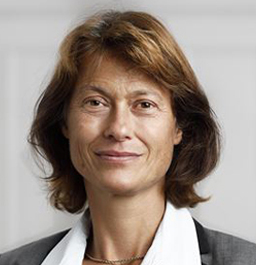
Sara Mazur, Executive Director Knut and Alice Wallenberg Foundation, underlined that many companies have dismantled their central research organisations in favour of placing research closer to business – a serious mistake, since short-term priorities always win when research shares resources with business units. She also pointed to growing earmarking of public research funding, and noted that Sweden’s fear of being seen as subsidising private firms severely limits productive collaboration. The Wallenberg Foundation supports basic curiosity-driven research and runs proof-of-concept grants that have helped seed more than 100 Swedish startups since 2017.

In the discussion, both speakers pointed to the growing distance between academia and industry, and to the problem of compressed timescales in a quarterly-driven economy. Arora partially dissented, arguing that the deeper issue is that investors prefer pure-play companies, making integrated industrial research the exception rather than the rule. There was broad agreement that long-term, committed owners are decisive – exemplified by Ericsson, which, as Mazur noted, likely would not have survived 2001 without them.

Ashish Arora, Sara Mazur, Björn Ekelund, Anders Broström

Concluding reflection

The seminar painted a picture of an innovation system in which the production of scientific breakthroughs is not the problem – the translation into commercial products is. The fragmentation between universities, startups and incumbents has clear parallels in Sweden. The question that remains is not how to produce more science, but how to rebuild the institutional connections that allow science to become prosperity.


Note: This summary has been compiled with the help of an AI model and should be regarded as an indicative account of what was said during the seminar. It may contain misinterpretations or factual errors and should not be considered a verbatim or authoritative record. For complete and accurate information, please refer to the original sources or the recording.