On December 12, Swedish Entrepreneurship Forum held a seminar where we discussed how, during the war in Ukraine, civil society demonstrated remarkable adaptability, cooperation, and resilience. The Ukrainian tech sector was also highlighted for its impressive ability to innovate, showing agile and continuous changes in development and production. Read more about the key findings below.
Summary*
Civil society – a social resource during times of crisis
Magnus Karlsson, Professor Marie Cederschiöld University
The presentation examined civil society as a critical social resource during crises and war, drawing on survey data and field visits to wartime Ukraine. It highlighted key differences and similarities between Sweden and Ukraine regarding democratic ideals, trust, and social capital. While Sweden is often seen as “best in class” in terms of democracy and generalized trust, Ukraine occupies a position between East and West but shows a clear westward orientation.
Important lessons for resilience
A central finding is that the two countries rely on different forms of social capital: Ukraine is characterized by strong bonding social capital—high trust within groups, shared norms, and tight networks—whereas Sweden relies more on bridging social capital, marked by generalized trust, tolerance, and openness across communities. The presentation also showed a strong link, in both countries, between participation in legal protests and willingness to defend one’s country, indicating that civic engagement is closely tied to societal resilience.
In conclusion, Sweden possesses important resources—high social trust, strong organizations, and cross-sector cooperation—but that these assets cannot be taken for granted. Ukraine’s civil society, shaped by revolution and war, may display levels of creativity and independence that Sweden partly lacks, offering important lessons for resilience and crisis preparedness.
 Andreas Flodström, Magnus Karlsson, Maryna Brychko, Pontus Braunerhjelm, Elly Reinolds
Ukraine’s resilience – what can Sweden learn?
Maryna Brychko, Senior Lecturer Blekinge Institute of Technology and Pontus Braunerhjelm, Research Director Swedish Entrepreneurship Forum and Professor Blekinge Institute of Technology
During the session, Braunerhjelm and Brychko approached Ukraine’s wartime resilience through the lens of the innovation system, with a particular focus on the drone sector. Resilience was not defined as stockpiling or centralized planning, but as the ability to rapidly adapt, iterate, and scale solutions under extreme pressure. Ukraine has built a distributed innovation system in which military users, civilian engineers, volunteers, and startups co-produce capabilities in real time. This is enabled by institutional flexibility, simplified procurement, dual-use technologies, and platforms such as BRAVE1. The result is a dramatic increase in production capacity and sharply reduced costs compared to the EU.
Do not copy – do reform
For Sweden, the key lesson is not to copy Ukraine, but to reform how defense innovation is organized: decentralize decision-making, involve users early, create crisis modes with fast processes, distribute production geographically, and integrate civilian tech environments into defense capabilities. Currently, Sweden’s defence sector is a bureaucratic system with long lead times and high thresholds. Braunerhjelm and Brychko argued for a more entrepreneurial, experimental, and collaborative defense innovation system. 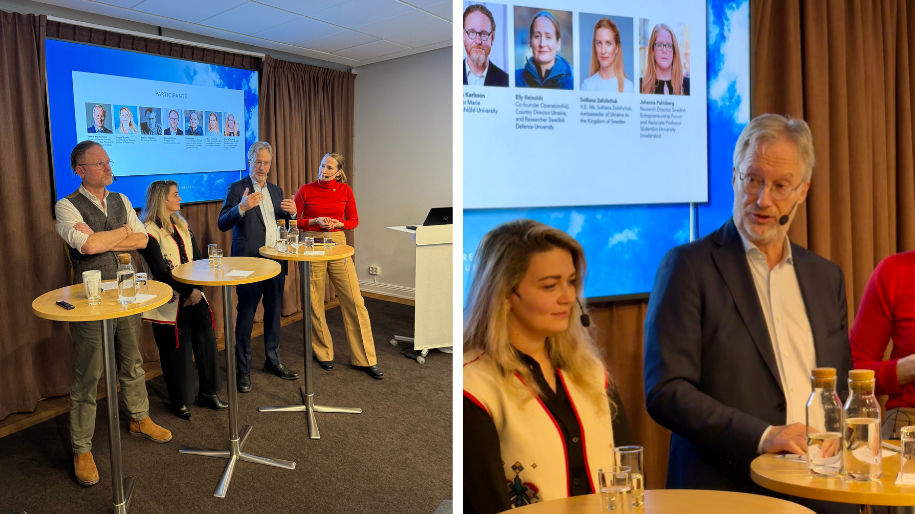
OperationAid in Ukraine
Elly Reinolds, Co-founder OperationAid, Country Director Ukraine, and Researcher at Swedish Defence University
During the seminar, Elly Reinolds presented the humanitarian and healthcare situation in Ukraine based on her work as a medical doctor, emergency preparedness expert, and co-founder of OperationAid Ukraine. She described how, after more than ten years of war, Ukraine faced an extreme and prolonged crisis: millions had been displaced, large parts of the country were occupied or heavily mined, and both civilians and soldiers were experiencing severe physical and psychological trauma. Particular attention was given to the scale of injuries, the growing need for mental health support, and the long-term impact on children, many of whom had lost access to schooling or lost one or both parents.
The importance of early preparedness
The presentation focused on crisis preparedness and civilian readiness, particularly training children and young people in frontline areas in lifesaving skills such as hemorrhage control, CPR, fire response, and mine awareness. Reinolds concluded with a call to action, arguing for deeper international partnerships, long-term and predictable funding for civil society, protection of humanitarian workers, and stronger youth-focused cooperation across borders. Drawing lessons from Ukraine, she stressed the importance of early preparedness, clear prioritization under difficult conditions, cross-sector coordination, resilient logistics and infrastructure, effective communication systems, and close cooperation between civilian and military actors, while posing the critical question of what Sweden’s greatest vulnerability might be in a comparable crisis.
Ukraine – an innovation hub in high-tech warfare
Andreas Flodström, Co-founder Beetroot
During the seminar, Flodström talked about Ukraine as an emerging global innovation hub in defence technology, drawing on his experience as co-founder and CEO of Beetroot and Beetroot Academy. He described how Ukraine’s strong engineering tradition and rapidly growing IT sector before 2022 laid the groundwork for a swift transformation from civilian tech to defence tech after the full-scale invasion. Grassroots innovation, decentralised military reforms, and platforms such as BRAVE1 were highlighted as key enablers of rapid experimentation, testing, procurement, and production.
Innovator’s dilemma
The presentation emphasized how modern warfare in Ukraine had become highly data-driven and software-centric, with drones accounting for the majority of frontline strikes and autonomous systems, AI, and electronic warfare playing central roles. Speed, cost-efficiency, networks, and market mechanisms were presented as decisive factors in technological warfare. Flodström argued that Western defence actors faced an “innovator’s dilemma” and risked falling behind unless they engaged directly with Ukraine’s fast, battlefield-driven innovation ecosystem. He concluded by outlining ongoing efforts to strengthen Ukraine through DefenceTech investments while simultaneously contributing to Europe’s long-term rearmament and security through collaboration with Ukrainian innovators
—–